Rainwater Attenuation & Infiltration Calculator
Attenuation crates & soakaways - volume, unit count, footprint, emptying time
Attenuation Tank
Throttle discharge to a permitted rate - store peak flows and release slowly to sewer or watercourse
Soakaway / Infiltration
Discharge surface water to ground via percolation through the soil - no connection to sewer required
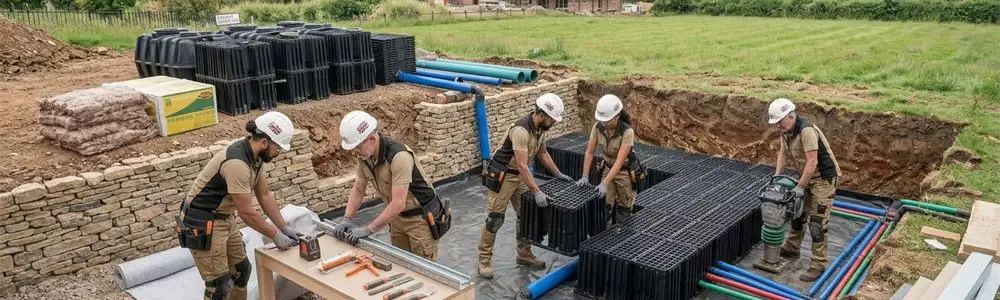
Modular Crates
Polypropylene interlocking crate system with ~95% void
Precast Tank
Concrete or GRP underground tank - bespoke volume
Oversized Pipe
Large-diameter pipe storage (600 mm dia)
Rainfall values below are approximate UK figures based on FEH/DEFRA data. For planning submissions use site-specific values from your drainage consultant or design software.
1 in 2 year
1 in 10 year
1 in 30 year
1 in 100 year
15 min
30 min
1 hour
2 hours
6 hours
♦ 13 mm
Catchment Areas
Max flow rate to sewer / watercourse as set by planning or the water authority. Use 0 for full attenuation with no discharge.
300 L
400 L
450 L
600 L
1,000 L
95%
90%
85%
x 1.10
x 1.15
x 1.20
x 1.30
Job Costing (optional)
Pro featurePopulate cost fields with current UK market prices. Sign in or upgrade to access.
Attenuation Results
🚫 Estimate waste & skip size for this project →
Doing this as a homeowner?
Who do you actually need to hire for this?
Not sure what some of these terms mean?
Browse all →
Frequently Asked Questions
What is rainwater attenuation and why is it required?
Attenuation temporarily stores surface water runoff to control the discharge rate to a watercourse or sewer - ensuring post-development peak flow does not exceed pre-development greenfield runoff rate. Required by the PPG on flood risk and SuDS on most new development sites in England, Wales, and Scotland. Typically sized for the 1 in 100-year + 40% climate change rainfall event.
What is the difference between attenuation and infiltration?
Attenuation: stores runoff and releases it slowly to a watercourse or sewer at a controlled rate - used where infiltration is not possible (high water table, clay soils, contamination risk). Infiltration (soakaway): stores runoff and drains it into the ground - requires suitable soil permeability (confirmed by a percolation test to BRE 365) and adequate depth to the water table.
How is attenuation volume calculated?
Using the CIRIA C753 SuDS Manual method: Volume (m³) = impermeable area (m²) x rainfall depth (m) x runoff coefficient - (permitted outflow rate x storm duration). Rainfall depths for design events are from the FEH (Flood Estimation Handbook) or the Environment Agency's ReFH2 tool. Critical event: typically 1 in 100-year storm with 40% climate change allowance.
What size soakaway crates do I need for a domestic driveway or roof?
Use the BRE Digest 365 simplified method: effective volume = 0.5 x impermeable area x rainfall depth for the 1 in 10-year storm (typically 10-20 mm). A standard soakaway crate provides approximately 400-450 litres (0.4-0.45 m³) storage at a void ratio of ~95%. A percolation test is needed to confirm the ground can accept the volume within an acceptable timeframe.
Do I need planning permission for a rainwater soakaway or attenuation system?
Drainage for new development is addressed through the planning application - a drainage strategy or SuDS report is typically required by the Local Planning Authority. Residential developments of 1+ dwellings must be agreed with the Lead Local Flood Authority (LLFA). Soakaways for existing properties replacing an existing connection: generally no planning permission needed but should comply with Environment Agency groundwater protection guidance.
What is the SuDS hierarchy and how does it affect drainage design?
The CIRIA C753 SuDS hierarchy (preferred order): (1) store for reuse; (2) infiltrate into ground; (3) discharge to a surface water body; (4) discharge to a surface water sewer; (5) discharge to a combined sewer. Designers should use the highest feasible option. Attenuation tanks are used where infiltration is not possible to achieve controlled discharge. The NPPF requires SuDS on all new major development.